

Visualizing integrated care pathways for heart failure and COPD
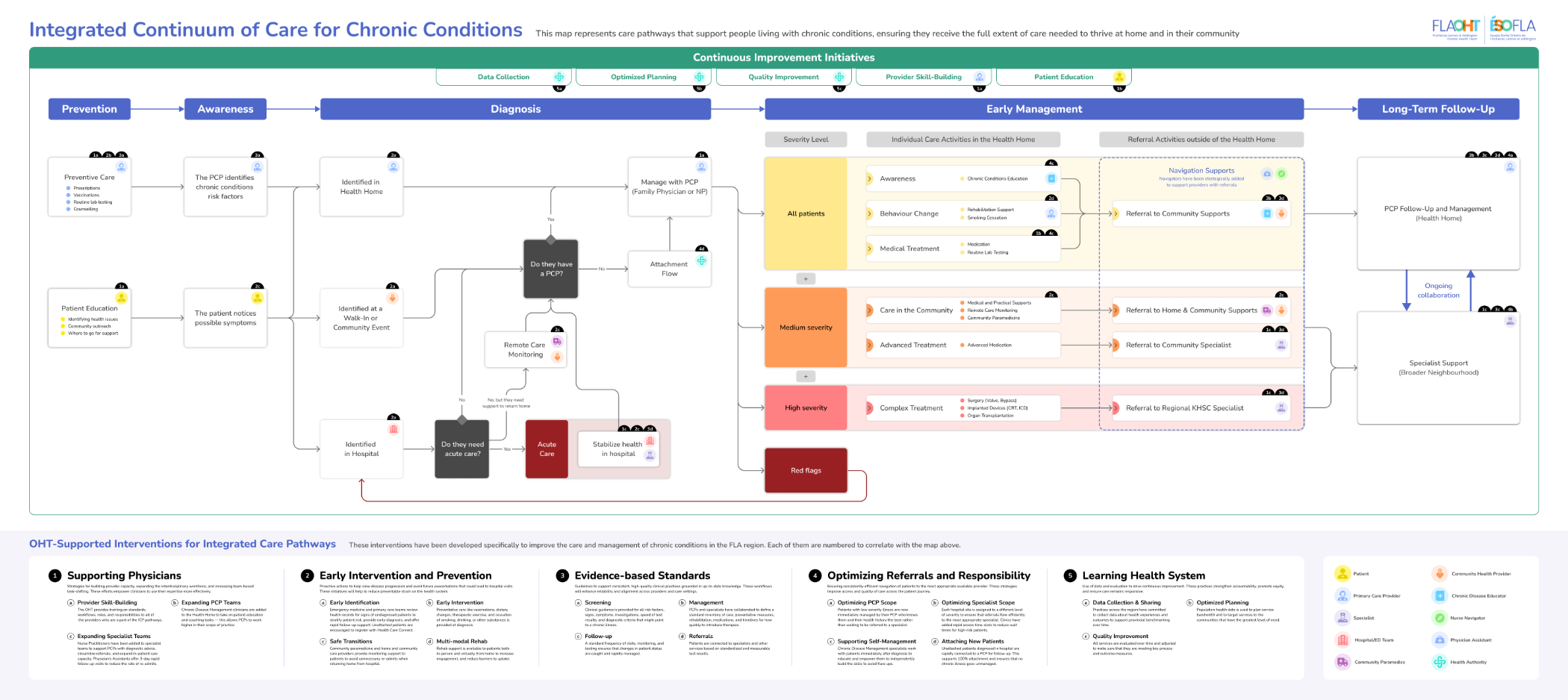
Creating a collaboration diagram with illustrations to show improvements in chronic disease management across the continuum of care, with positive impacts in patient care and provider workflows.
CLIENT
Frontenac Lennox & Addington Ontario Health Team (FLA OHT)
WITH
Healthcare Human Factors
Challenge
Managing chronic conditions such as congestive heart failure (CHF) and chronic obstructive pulmonary disease (COPD) requires ongoing collaboration between patients and healthcare providers across the health system. If conditions are left undiagnosed or untreated, patients may end up with more hospitalization, more specialized care, and recurring negative health outcomes.
The Frontenac Lennox & Addington Ontario Health Team (FLA OHT) took note of this data and developed integrated care pathways (ICPs) to improve care for people living with chronic disease. The goal is to make disease management more accessible through primary care and community partners, and divert patients away from needing more acute and specialized care. As a designer with Healthcare Human Factors, our team was brought in to identify key messages and care improvements to highlight to key stakeholders, to visualize workflows that optimize care, and create assets that support communication with diverse care partners.
Process
We also crafted unique illustrations for each care improvement to support communication strategies with patients and providers. The illustrations are intended for use with informative presentations and online resources about ICPs to key stakeholders. Altogether, our deliverables helped to gather different FLA OHT initiatives and present them as a holistic effort in improving chronic disease management in their health region.

We started by reviewing current pathway and workflow documents used by clinicians in the health region, which helped us gain understanding about the disease management journey for patients suspected of having CHF or COPD. The pathways align with FLA OHT’s ongoing initiative of “Person-Centred Health Homes” and its goal to attach every person to a primary care team in the community where they live.
The ICPs outlined the different phases of chronic disease management and what to do at each stage. By immersing ourselves with clinical knowledge and best practices, we came to understand the pathways and visualize them based on:
Optimal levels of patient care, considering the symptoms presented, risk to patient health and severity of condition
The patient’s care journey, ranging from awareness to treatment to ongoing management
The location where care can be provided, in their community and regionally
The care providers involved in managing the condition at different stages.
In all, we came to highlight 5 themes and identified 18 improvements that are being made possible through the introduction of the ICPs. This resulted in a collaboration diagram that clarified the care pathways and phases of disease management for CHF and COPD,
Outcome
FLA OHT intends to use the tools we developed to support primary care providers through education and skill-building for better management of CHF and COPD, with plans to add more chronic conditions to the care pathways in the future. By leveraging the foundational work they have already built through the Health Homes model, our tools provided FLA OHT with assets to bring more providers onboard and opened the door for future decision-making tools that assist providers with chronic disease management based on regional data and best clinical practices.
Reflection
This project taught me a lot about working with ambiguity. While the challenge was clear, defining our final deliverables was only possible through months of regular meetings with our client and uncovering what they needed to move forward in their objectives. Once that was better defined, we brought them along the design process to provide feedback on works-in-progress and ensure we are aligning with their project scope.
Because of our regular meetings and existing working relationship from a previous project, we came to trust each other and build effective rapport that led to the successful development of communication tools. By aligning visually and consistently with their existing brand assets, we left an open opportunity for FLA OHT to re-engage with our team on future work and continue a successful partnership.